MoneyGram vs Remitly: Which Money Transfer Service is Better in 2025?
Benjamin Clark - 2025-10-11 09:16:20.0 3513

Introduction
Cross-border money transfers have evolved rapidly, but users still face pain points such as high fees, slow delivery times, exchange rate markups, and limited payout options. Choosing the right provider can significantly impact how much your recipient receives.
In this article, we compare MoneyGram vs Remitly, two major players in the digital payments and remittance industry. We analyze their costs, exchange rates, speed, security, and coverage to help you make an informed decision. We’ll also highlight Panda Remit as a growing alternative with low fees and strong rates.
For background on remittances, see Investopedia.
MoneyGram vs Remitly – Overview
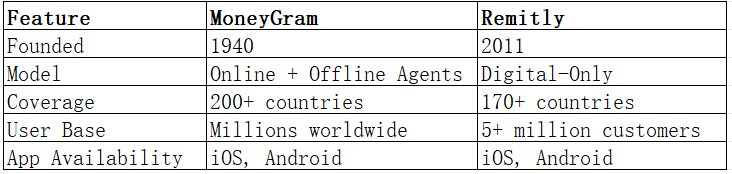
MoneyGram, founded in 1940, is one of the world’s largest money transfer companies, serving millions globally through over 400,000 agent locations and a robust digital platform.
Remitly, launched in 2011, is a digital-first remittance provider focused on low-cost, fast international transfers through its user-friendly app and online platform.
Similarities:
-
Both offer international money transfers to a wide range of destinations.
-
Both support mobile apps and web platforms.
-
Both provide options for cash pickup and bank transfers.
Differences:
-
MoneyGram maintains a strong offline agent network, while Remitly is entirely digital.
-
Remitly often offers lower upfront fees, but may include exchange rate markups.
-
MoneyGram is ideal for cash-based users, while Remitly targets mobile-first users.
Panda Remit has emerged as another competitive option in the global remittance space, combining low fees with digital convenience.
MoneyGram vs Remitly: Fees and Costs
MoneyGram typically charges fixed fees based on destination, payment method, and payout type. Cash pickups often cost more than bank transfers. Urgent transfers may incur higher fees.
Remitly uses a two-tier fee system:
-
Economy transfers: lower fees, slower delivery.
-
Express transfers: higher fees, near-instant delivery.
Fees depend on corridor, amount, and payment method. Credit card payments usually have extra charges.
According to NerdWallet, Remitly generally beats MoneyGram on digital transfer fees, while MoneyGram remains competitive in cash-based corridors.
Panda Remit often provides lower fees overall, especially for bank-to-bank transfers.
MoneyGram vs Remitly: Exchange Rates
Exchange rates are crucial to the total amount received.
MoneyGram applies a markup over the mid-market rate, usually ranging from 1% to 5%, depending on the currency.
Remitly frequently offers promotional mid-market rates for new users, which may become less competitive after the promotion ends.

Panda Remit often offers closer-to-mid-market rates, making it attractive for those seeking better currency value.
MoneyGram vs Remitly: Speed and Convenience
MoneyGram is known for instant cash pickup, though bank transfers can take 1–2 business days.
Remitly’s Express transfers are typically near-instant, while Economy transfers may take 3–5 days but cost less.
Both platforms have user-friendly mobile apps, though Remitly is frequently praised for its interface and clear timelines.
For more on transfer times, see the World Bank speed guide.
Panda Remit offers fast, fully online transfers, often completed within minutes depending on the corridor.
MoneyGram vs Remitly: Safety and Security
MoneyGram is licensed in multiple jurisdictions, using encryption, identity checks, and fraud prevention.
Remitly is regulated in the U.S., Canada, EU, and other markets, with bank-level security and real-time monitoring.
Panda Remit is also fully licensed and regulated, offering a secure environment for users.
MoneyGram vs Remitly: Global Coverage
MoneyGram leads with 200+ countries and territories supported and multiple payout methods including cash pickup, bank deposits, and mobile wallets.
Remitly covers 170+ countries, mainly through digital channels. While its offline reach is limited compared to MoneyGram, it performs strongly in popular migrant corridors.
For global remittance data, see World Bank Reports.
MoneyGram vs Remitly: Which One is Better?
-
MoneyGram is ideal for users needing cash pickup, extensive geographic coverage, and a trusted brand.
-
Remitly is best for digital-first users seeking low upfront fees and a smooth app experience.
For users prioritizing low fees, strong exchange rates, and fast digital service, Panda Remit (https://www.pandaremit.com) stands out as a strong alternative.
Conclusion
The MoneyGram vs Remitly comparison reveals two distinct strengths: MoneyGram offers unmatched offline reach and instant cash options, while Remitly provides a streamlined digital experience with competitive fees.
However, for users seeking to maximize the received amount and enjoy fast, all-online transfers, Panda Remit (https://www.pandaremit.com) combines low fees, high exchange rates, and flexible payment methods (POLi, PayID, bank card, e-transfer, and more) across 40+ currencies.
For further reading, visit NerdWallet or the World Bank.